
What a Searchable Call Transcript Means for Your Next Bank Exam
A searchable call transcript lets your bank find and read what was said on a call in seconds, instead of locating a recording, queuing it up, and listening until you reach the right minute. It doesn't change which records your bank is required to keep. What it changes is how quickly you can produce the calls behind those records — wire transfer confirmations, loan disclosures, account-change requests — when an examiner, auditor, or customer asks what was said. This guide covers what the recordkeeping rules actually require, where transcripts help and where they don't, and what to confirm before you rely on them.
Why Does a Call Transcript Matter When Someone Asks "What Was Said?"
Most community banks already depend on phone calls for activity that matters: a customer confirming wire instructions, a loan officer walking through terms, a branch employee processing an address change. When one of those is questioned — by an examiner reviewing your controls, an internal auditor sampling transactions, or a customer disputing what they agreed to — the question is always the same. What exactly was said, and can you show it?
With audio alone, answering means finding the right file and listening to it. Picture a 9-branch community bank in central Oklahoma where an internal auditor asks for every call last quarter in which a customer changed wire instructions. With an audio archive, that is a lot of listening. With a searchable transcript, it starts with a search.
What Records Does a Community Bank Already Have to Keep?
Transcripts aren't the starting point; the recordkeeping rules are. Two matter most for phone-based activity like the examples above.
Funds transfers of $3,000 or more. Under 31 CFR 1020.410, a bank handling a funds transfer of $3,000 or more must retain records that include the originator's name and address, the payment amount, the execution date, any payment instructions from the originator, and the identity of the beneficiary's bank, along with the beneficiary details it received with the order. The originator's bank must be able to retrieve that information by the originator's name and, for established customers, by account number.
Retention and access. Records required under the BSA regulations must be kept for five years and filed or stored so they are "accessible within a reasonable period of time," according to 31 CFR 1010.430.
Neither rule requires a call transcript. But where payment instructions arrive by phone, the call is part of how many banks document what the customer actually asked for — and a transcript you can search by customer name is a practical way to show that call can be found when it's needed. Your own policies, your state regulator, and your examiner's expectations may call for more than the federal baseline. Confirm specifics with your compliance officer or counsel; this guide is general information, not legal advice.
Audio Recordings vs. Searchable Transcripts: What Actually Changes?
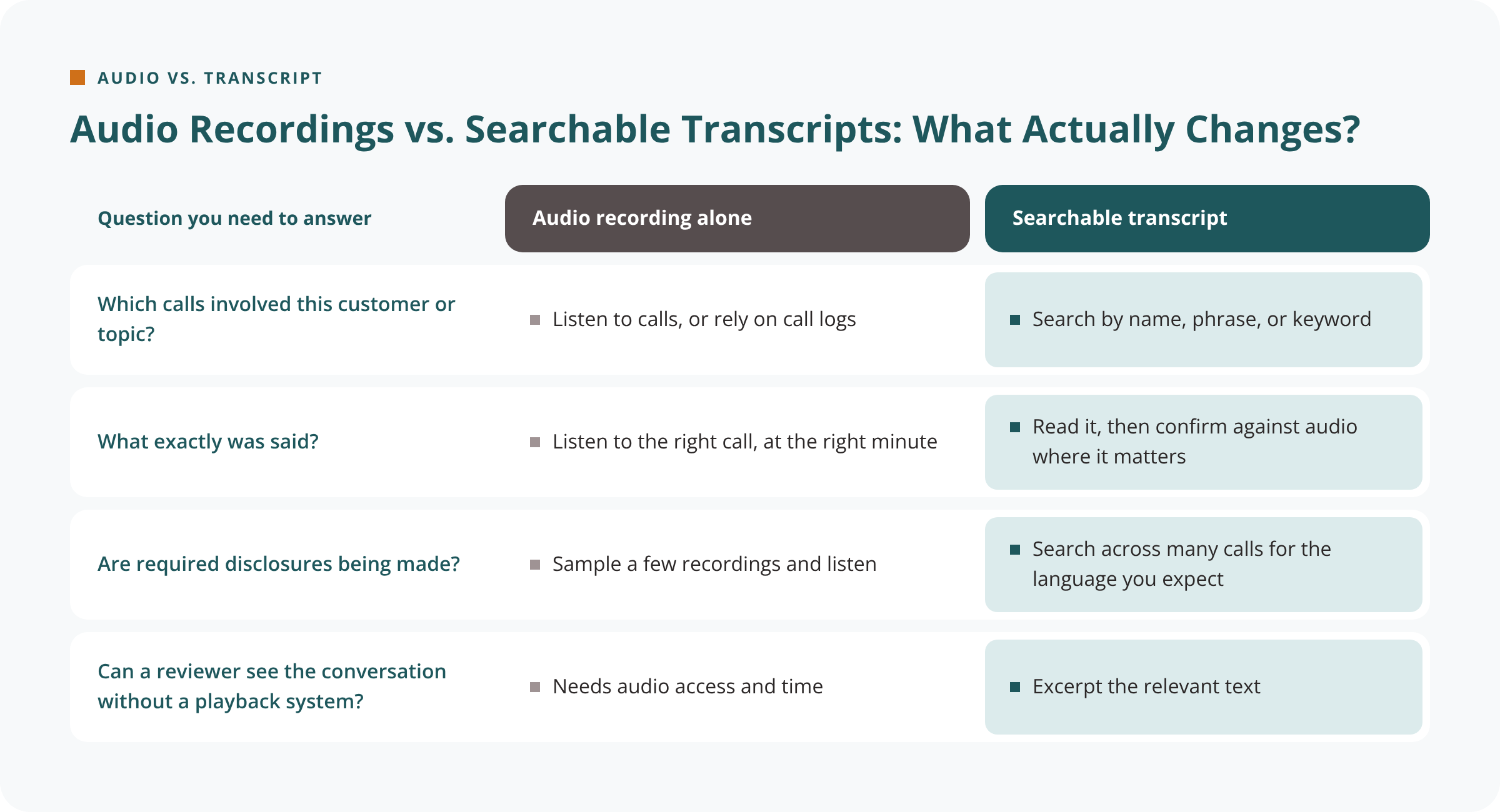
Transcripts do not replace audio. They are generated by AI, and a misheard name or number is possible, especially on a poor connection. Where exact wording matters, treat the transcript as a finding aid and confirm against the recording your procedures call for.
How Do Verge's AI Call Solutions Support Exam Readiness?
Verge solutions transcribe calls and voicemails, and AI-generated summaries log directly to your CRM when integrated. Because transcripts are searchable across calls, a compliance officer or supervisor can look for a keyword or phrase instead of listening through recordings one at a time. Verge's infrastructure is also SOC 2 Type II compliance certified.
To be precise about what that means: it is a documentation aid. It makes the calls you already rely on easier to find and review.
What Should You Confirm Before You Rely on Transcripts for Compliance?
- Retention. How long are transcripts kept, who can change that setting, and how does deletion work? Match the answer to your records retention schedule — five years for records required under the BSA regulations, and longer if your own policy says so. Ask about retention configuration during your quote conversation.
- Access. A transcript holds customer information. Decide who can search it, who can export it, and how that access is reviewed, and make sure it falls under your information security program the same way recordings do.
- Accuracy review. Decide who spot-checks transcripts for your most sensitive call types, and how a correction is noted.
- Disclosure and consent. Federal law allows recording when one party to the call consents, unless the recording is made to commit a criminal or tortious act (18 U.S.C. § 2511(2)(d)). Some states require every party to consent, and calls that cross state lines can complicate things. Start with how your bank discloses recording today, and ask counsel whether anything changes when AI transcription is added.
- Provider due diligence. The June 2023 interagency third-party risk management guidance from the OCC, the Federal Reserve, and the FDIC describes a life cycle that runs from planning through due diligence and selection, contract negotiation, ongoing monitoring, and termination. It also notes that "not all third-party relationships present the same level of risk or criticality to a bank's operations," so scale your review to the data involved. For call data, that includes how the provider handles retention, your ability to access your data, and its independent audit reports.
Where Should a Bank Start?
You don't need a full rollout to find out whether transcripts help. A practical first pass looks like this:
- List the call types your bank already treats as records — wire confirmations, loan disclosures, account changes.
- Write down the questions you'd need to answer quickly, such as "every call with this customer in the last 90 days."
- Ask your provider how transcripts are retained, accessed, and exported.
- Pilot with one team, and review a sample of transcripts against the audio before you expand.
Built for Your World
Every industry has unique needs—and Verge understands the details. We’ve spent over two decades building solutions that align with the operational, regulatory, and customer demands of your sector.